By Francisco Gallegos
Understanding the AI Maturity Matrix
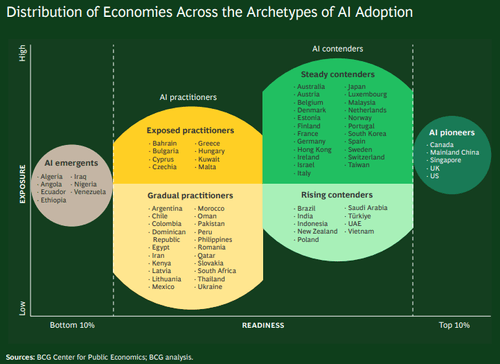
In November 2024, Boston Consulting Group released a groundbreaking study titled "The AI Maturity Matrix: Which Economies Are Ready for AI?" As global AI spending races toward $632 billion by 2028, this first comprehensive framework evaluates how 73 nations are positioned to either harness or struggle with the AI revolution.
The matrix examines economies through two critical lenses: exposure to AI-driven disruptions and readiness to leverage AI opportunities. Exposure considers how vulnerable different sectors within an economy are to AI impacts, while readiness is measured through the ASPIRE framework (Ambition, Skills, Policy and regulation, Investment, Research and innovation, and Ecosystem). The findings reveal a stark reality: only five economies—Canada, China, Singapore, the UK, and the US—have achieved "AI pioneer" status. These nations have transformed potential AI disruption into competitive advantage through strategic investments, robust infrastructure, and cultivated talent pools.
Latin America presents a concerning contrast to these AI pioneers. Ecuador is categorized among the "AI emergents"—economies at the earliest stages of AI adoption alongside Algeria, Angola, Ethiopia, Iraq, Nigeria, and Venezuela. This places Ecuador in the bottom 10% of global AI readiness. What makes this particularly notable is that Ecuador is one of only two Latin American countries (with Venezuela) in this lowest-tier category, while regional neighbors like Brazil, Chile, and Colombia have achieved higher positions.